

Thai arts and crafts represent a heritage shaped over centuries of trade with China, India, Persia and the Malay world, whilst remaining deeply rooted in local religious and courtly traditions. It is a heritage which unlike in many other countries in the region has largely survived industrialisation and is still practised today, not just in […]
Thai arts and crafts represent a heritage shaped over centuries of trade with China, India, Persia and the Malay world, whilst remaining deeply rooted in local religious and courtly traditions. It is a heritage which unlike in many other countries in the region has largely survived industrialisation and is still practised today, not just in museums.
Silk and the man who revived it
Thai silk, known today throughout the world for its characteristic lustre and intense colours, underwent a dramatic revival in the mid-20th century thanks to Jim Thompson – an American businessman and, as it later transpired, a figure with murky links to the intelligence services – who, after the Second World War, became fascinated by local weaving and helped build it into a globally recognised luxury brand. Today, traditional silk weaving is still practised primarily in the Isan region, including in Surin province, where the distinctive mudmee pattern is produced – achieved using a technique of tie-dyeing the threads before weaving begins, similar to Indonesian ikat.
Pottery from the Sukhothai Kingdom
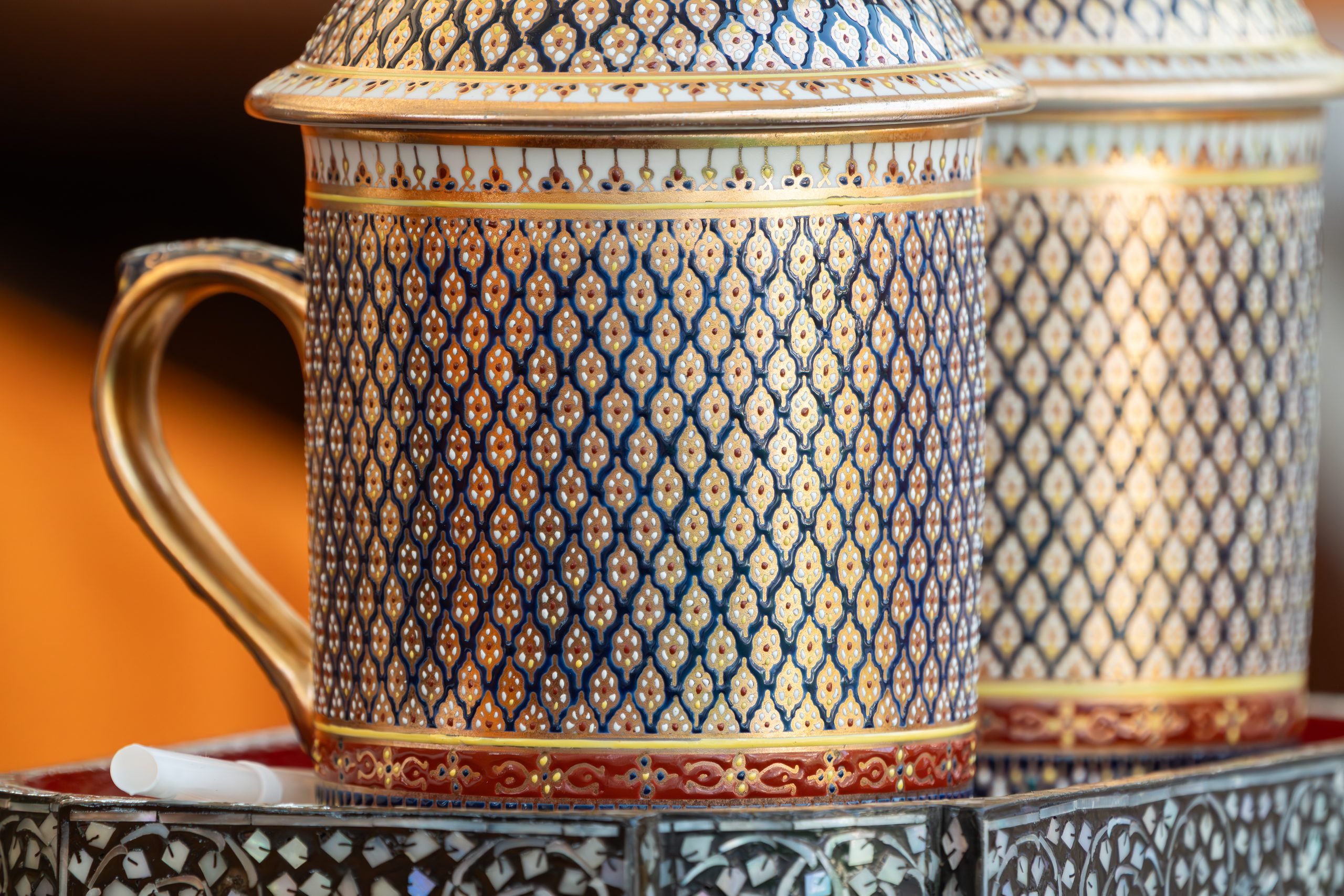
Sangkhalok pottery, produced during the Sukhothai Kingdom between the 13th and 15th centuries, was in its day an export commodity of regional significance, finding its way onto merchant ships bound for China, Vietnam and the Philippines. The distinctive patterns featuring floral and fish motifs continue to inspire contemporary Thai potters, whilst the original pieces are now sought-after collector’s items, sometimes recovered from the wrecks of ships that sank in the Gulf of Thailand several hundred years ago.
Wood, gold and sacred architecture
Teak wood carving, characteristic of sacred architecture and traditional houses in the north of the country, can still be seen today in the temples of Chiang Mai and Lampang. The gables of temple roofs, known as po chofa, resemble stylised heads of the mythical bird Garuda or the serpent Naga – these elements are not merely decorative, but have cosmological significance, symbolising the protection of the temple from evil spirits. The gilding of Buddha statues and architectural elements using gold leaf is a religious practice that continues to this day – worshippers may apply small pieces of gold leaf to the statues themselves as an act of merit (tham bun).
Lacquerwork and the art of miniatures
Less well-known but equally fascinating is the tradition of lacquerwork (khrueang khern), practised particularly in the Chiang Mai region a technique involving the repeated application of natural lacquer resin to wooden or bamboo objects, which are then decorated with gold patterns. This technique can still be seen in action today in some family-run workshops that have been producing these items for generations.
Where to see it in action
For those interested in both observing the creative process and shopping, craft markets such as the Chiang Mai Night Bazaar, and craft villages on the outskirts of the city – such as Bo Sang, famous for its hand-painted paper and silk umbrellas, where the entire production process, from forming the paper from mulberry bark to the final painting, takes place in full view of tourists.